HAS ARTIFICIAL GENERAL INTELLIGENCE REACHED GATWICK?
While a flight-processing failure left thousands of passengers stranded, AI claimed a 90-year-old maths breakthrough and was given a 10% chance of causing human extinction. Vânia La Rocca brings these events together to examine the gulf between frontier claims and everyday technology.
By Vania La Rocca
Nobody called it AI. Artificial General Intelligence (AGI) had not reached Gatwick, after all.
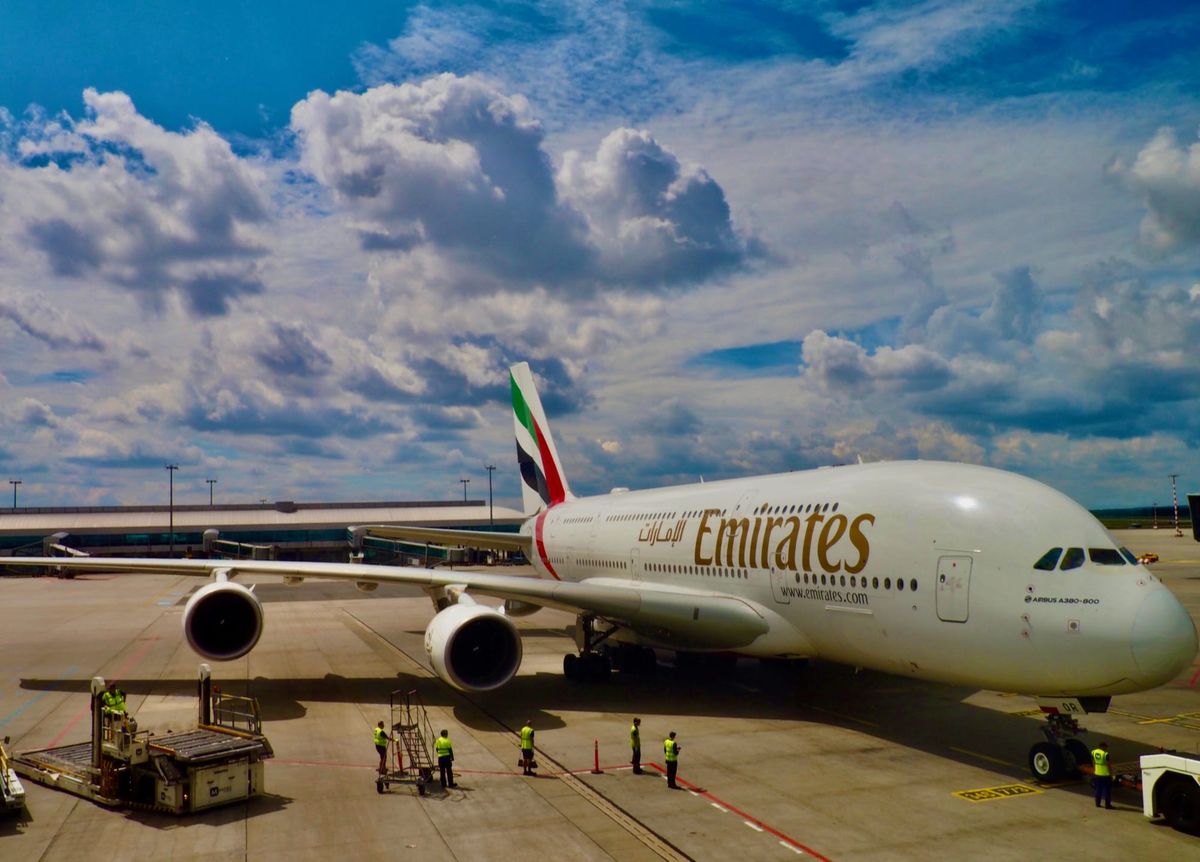
On the afternoon of Tuesday 8 September 2026, passengers in Gatwick’s South Terminal sat on the floor with their luggage and waited. Aircraft remained on their stands. The system processing flight plans had failed, and until it resumed, very little could depart. By eight that evening, more than a thousand flights had been cancelled.
The Guardian reported 177 further cancellations the next day, nearly all of them at Heathrow, and knock-on delays across Europe. Ryanair reported that more than 65,000 of its own passengers had flights delayed due to the incident. Later, Cirium figures put Tuesday’s UK-wide total at approximately 1,750, with more than 2,000 cancellations across Tuesday and Wednesday. Heathrow suspended arrivals for the rest of the night, while the disruption produced knock-on delays across Europe. Ryanair said more than 65,000 of its passengers had been delayed.
Nobody called it AI. Artificial General Intelligence (AGI) had not reached Gatwick, after all.
What we had been told
The AGI era, then. A claimed solution to a ninety-year-old problem produced in under four days. A one-in-ten chance of extinction. Six days of headlines, all orbiting machines' capabilities or dangers.
Five days earlier, at a closed press briefing for GPT-6 Astra, OpenAI president Greg Brockman told reporters it was reasonable to say that the AGI era had begun. He ended the briefing with: “Welcome to the AGI era.”
ARC Prize published two results for GPT-6 Astra: 62.7 per cent under its Standard harness and 99.9 per cent using OpenAI’s Provider Adapter. OpenAI reported only the 99.9 per cent result. ARC-AGI-3 tests models in novel, abstract environments whose rules and objectives are not explained in advance but must be inferred through interaction.
On the same Tuesday as the Gatwick disruption, OpenAI published what it said was a proof of the Navier–Stokes existence and smoothness problem. The underlying mathematical question dates back roughly 90 years and was later designated one of the seven Millennium Prize Problems. Around 10,000 agents had worked on it concurrently and achieved the result in 88 hours. OpenAI subsequently formalised the proof in Lean and said it had been machine-checked. It did not intend to claim the prize. Instead, it gave mathematicians the option to decide.
The next morning, the BBC reported that Evan Hubinger, Anthropic’s Alignment Science Lead, had written that he put the chance that AI “could kill all humans” within the next decade at more than one in ten. He was responding to a former colleague, Jacob Coxon, who had just resigned and said that neither Anthropic nor OpenAI was behaving responsibly. By that morning, Hubinger’s post had more than ten million views.
The AGI era, then. A claimed solution to a ninety-year-old problem produced in under four days. A one-in-ten chance of extinction. Six days of headlines, all orbiting machines' capabilities or dangers.
What actually stopped
During a national aviation shutdown, 26 minutes of recovery time were lost partly to a login problem.
NATS provides air traffic control services to 15 UK airports. At 1.46 pm that Tuesday, it said it was investigating a technical issue affecting departures. It located the problem in its flight-processing system and announced a fix at 4.40 pm, just under three hours after its first public statement. This was the third major stoppage in just over three years, after the failure of August 2023 and a twenty-minute fault at Swanwick in July 2025 that produced 122 cancellations by Cirium’s count.
Martin Rolfe, the NATS chief executive, told Sky News that evening that “these things are relatively rare”. The cause of the latest outage remained under investigation. The August 2023 incident, however, is known in unusual detail. A correctly filed flight plan arrived carrying two waypoints with the same three-letter code: DVL. One was Devils Lake, North Dakota. The other was Deauville, France. They are about 4,000 nautical miles apart. The processing logic interpreted DVL in a way that placed the aircraft’s calculated exit from UK airspace before its entry into UK airspace.
Unable to construct a credible route, the system raised a critical exception and entered maintenance mode. The backup system, given the same flight plan, did the same. The whole sequence took twenty seconds. For almost six hours, staff manually entered flight plans.
The engineer expected to perform the full restart was on remote standby that bank holiday and reached Swanwick at 11.47 am. When the system finally came back up, it did so on the server in the pair that did not hold the password database. The engineer entered the correct password. The server could not verify it.NATS’s own report recorded a 26-minute recovery delay, attributable in part to the authentication problem.
The independent review that followed estimated that more than 700,000 passengers had been affected and issued 34 recommendations. During a national aviation shutdown, 26 minutes of recovery time were lost partly to a login problem.
What actually arrived
The AI that has reached everyday life is in a consulting room, listening. Forty per cent of the 598 UK general practitioners surveyed said they used an ambient scribe, on average across 60 per cent of their appointments, according to research published in npj Digital Medicine in May.
The machine listens to the consultation, transcribes it and produces the clinical note. The most common reason for choosing a particular system was a colleague’s recommendation. The regulatory and medico-legal questions remain open.
On 4 September 2026, four days before the Gatwick disruption, the University of Edinburgh announced the results of a review of 27 articles examining these systems and their implications. The scribes work from speech. A face, a gesture, a patient’s emotional state: none of it is contained in the audio.
The review found concerns that patients may be more hesitant to disclose sensitive information when they know a consultation is being recorded and processed by AI. The material potentially withheld includes substance misuse, domestic abuse and mental-health difficulties.
Write down what was said in the room. It is one of the simplest useful things you can ask an artificial intelligence to do. But what the resulting record risks missing is the person who said it.
The Asymmetry
Put the two worlds side by side, and what emerges is not distance. Distance would mean one road, with the airport and the surgery somewhere behind the frontier, waiting for their turn.
What emerges is an asymmetry.
One world is rewarded for intelligence. The other pays for failure. And somewhere between them is a password database on one server.
After spending this year reading the frontier’s announcements, I stopped believing that everyday life is behind. Instead, it runs under different rules.
The frontier brings enormous capability and attracts the rewards, while the consequences remain deferred. In everyday life, capability is whatever has been installed, the cost falls on the person on the floor, and the consequence is immediate. The most capable systems ever built are pointed at Millennium problems and at accelerating their own research because those achievements can be scored, announced and priced.
The way frontier technology is funded, built, and celebrated directs attention towards such achievements, rather than towards the resilience of a flight-plan parser or what a patient decides not to say.
A country’s departing flight can be halted by getting three characters wrong during an authentication. In the consulting room, a person is dropped by the same machine preserving their words.
These failures are public and immediate, yet fixing them attracts little of the prestige attached to a frontier breakthrough.
In the same week, OpenAI claimed to have found a solution to a ninety-year-old mathematical problem. A president declared an era. A researcher named the odds of extinction. None of these claims faced an immediate public test comparable with a grounded flight.
A forecast cannot fail immediately. On a Tuesday afternoon, on the floor of Gatwick’s South Terminal, something did.
